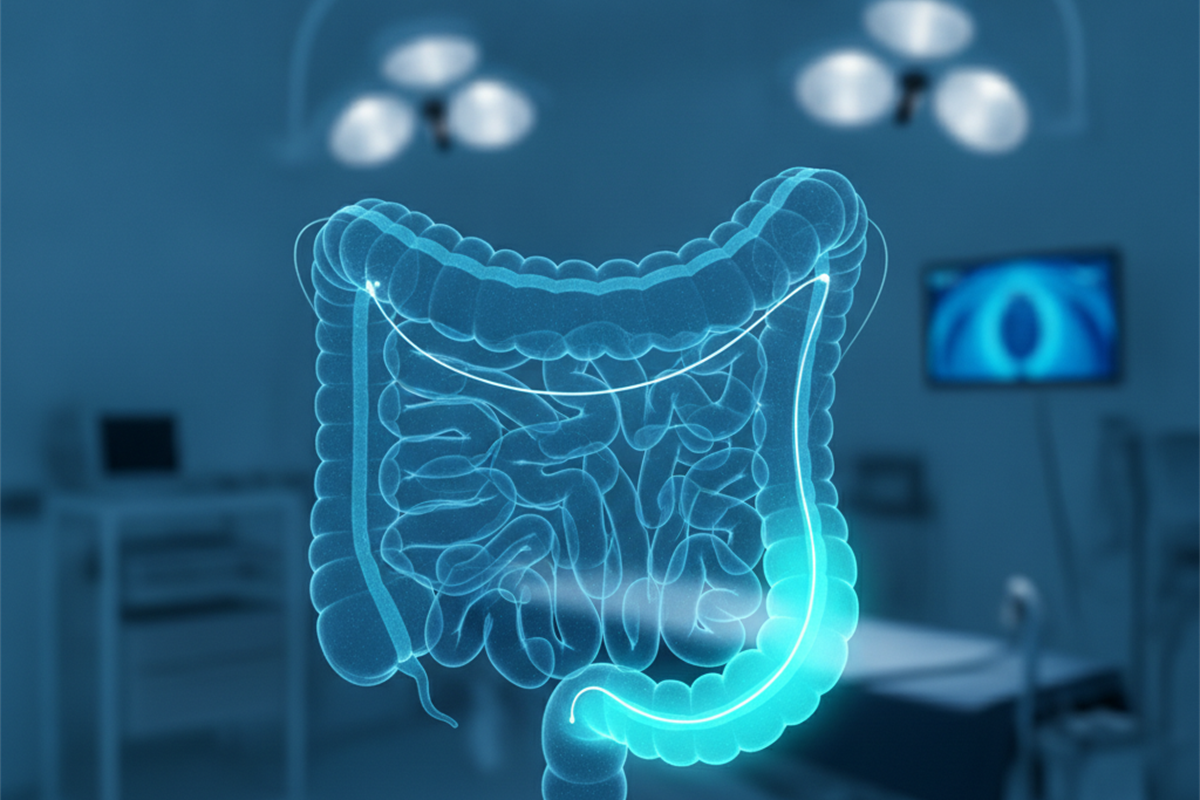

If you were told you would be having a rectosigmoidoscopy but were expecting a colonoscopy, it’s natural to wonder if you’re undergoing an incomplete examination. That’s not the case: they are different tests with different purposes, and each has its own medical indication.
This guide explains how they differ and when to choose each one.
The key difference: how far they go
Both procedures examine the large intestine using a flexible endoscope. The difference lies in the scope.
A rectosigmoidoscopy examines the final section—the rectum and sigmoid colon—approximately the last 60 centimeters.
A colonoscopy examines the entire large intestine, from the rectum to the cecum, where it joins the small intestine.
To put it simply: one reviews the latest chapter, the other the entire book.
Practical Comparison
- Scope. Rectosigmoidoscopy: rectum and sigmoid colon. Colonoscopy: entire colon.
- Preparation. Rectosigmoidoscopy requires much simpler preparation, often limited to cleansing the lower end of the colon. Colonoscopy requires complete cleansing of the colon, which is the part that patients describe as the most uncomfortable.
- Sedation. A rectosigmoidoscopy can be performed without sedation or with light sedation. A colonoscopy is usually performed with sedation.
- Duration. The first one is significantly shorter.
- Recovery. Without deep sedation, a rectosigmoidoscopy allows you to resume your normal activities almost immediately. After a colonoscopy, you cannot drive for the rest of the day.
When Is a Rectosigmoidoscopy Recommended?
- Bright red bleeding with a clear suspicion of a lower source
- Evaluation of Hemorrhoids, Anal Fissures, or Rectal Lesions
- Follow-up for proctitis or inflammatory disease limited to the distal segment
- Specific rectal symptoms: pain, discharge, tenesmus
- Situations where a quick answer is needed regarding a specific area
When Is a Full Colonoscopy Needed?
- Colon cancer screening. There is no substitute for this: the entire colon must be examined, because lesions can occur in any section.
- Family history of colorectal cancer or polyps
- Anemia of unknown cause
- Persistent change in bowel habits
- Occult blood detected in the laboratory
- Follow-up After Polypectomy
- Abdominal pain or unexplained weight loss
Important note: A normal rectosigmoidoscopy does not rule out a problem in the right colon. If the goal is to prevent colorectal cancer, the recommended test is a full colonoscopy.
Can polyps be removed from both?
Yes. In either procedure, if a polyp is found within the scope of the endoscope, it can be removed and sent for testing during the same procedure.
The difference is that a rectosigmoidoscopy can only diagnose what it is able to see.
How Is It Decided?
The choice depends on the reason for the visit, the patient’s age, family history, and the pattern of symptoms. Bright red bleeding in a young person with no prior history is not evaluated in the same way as anemia in a 60-year-old.
That decision is up to the gastroenterologist after evaluating you. If you have any questions about the test you were prescribed, bring them up during your appointment: understanding why one option was chosen over another is part of the process.
Both studies at CEGAS
At CEGAS, we perform rectosigmoidoscopy and full colonoscopy using high-definition equipment at Plaza Comercial San Fernando in Panama City.
Schedule your appointment, and let’s figure out which option is right for you.
Related Reading
- Endoscopy vs. Colonoscopy: How They Differ
- Colon Cancer: At What Age Should You Have Your First Colonoscopy?
- Preparing for a Colonoscopy: A Step-by-Step Guide
This content is for informational purposes only and is not a substitute for a medical consultation. Your specialist should always be the one to recommend the test.